Astro Info Service Limited
Information Research Publications Presentations
on the Human Exploration of Space
Established 1982
Incorporation 2003
Company No.4865911
E & OE
Gemini 3
GEMINI 3 MISSION REPORT |
LAUNCH DATA |
|
|
Launch |
23 March 1965. 09:24:00 EST |
Launch Site |
Pad 19, Cape Kennedy, Florida, USA |
Launch Vehicle |
Titan II Gemini Launch Vehicle No. 3 (GLV-3) |
Spacecraft |
Spacecraft No. 3 |
Spacecraft Mass |
Approx. 3,237 kg (7,136 lb) |
|
|
MISSION OBJECTIVE |
First crewed test flight of the Gemini spacecraft; test of orbital manoeuvring system. |
|
|
CREW DATA |
Crew Position |
Name |
Mission |
Command Pilot |
Virgil I. 'Gus' GRISSOM, 39
USAF. |
2nd |
Pilot |
John W. YOUNG, 35
USN. |
1st |
|
|
|
Flight Crew |
2 |
Call Sign |
Gemini Three / 'Molly Brown' |
Back-up Crew |
Walter M. Schirra (Command Pilot)
Thomas P. Stafford (Pilot) |
EVAs |
None (none planned) |
|
|
MISSION DATA |
Flight Duration |
4 hours 52 minutes 31 seconds |
Distance Travelled |
Approx 128,748 km (80,000 miles), completing 3 orbits |
Orbital Data |
161.2 x 224.2 km (100.1 x 139.3 miles), with a period of 88.3 minutes |
Landing |
23 March 1965. 02:16:31 EST |
Landing Site |
Western Atlantic Ocean, near Grand Turk Island; recovery ship USS Intrepid |
|
|
First Manoeuvres in Orbit
The inaugural crewed flight in the two-man Gemini series was a short, three-orbit evaluation of the spacecraft and systems with a crew on board. This initial crewed flight became the first spacecraft to adjust its orbit, a key requirement for subsequent rendezvous and docking missions planned for the Gemini series. Mission commander Gus Grissom also became the first person to fly into space twice, having previously flown as Pilot on the sub-orbital Mercury Redstone 4 mission in 1961. Though short, the flight of Gemini 3 was very successful and set the stage for more ambitious missions that would address the Gemini programme's objectives of long duration flights of up to two weeks, rendezvous, docking and spacewalking. These were all key experiences needed prior to embarking on sending the three-man Apollo missions to the Moon.
Two previous uncrewed missions had qualified the design and profile intended for the Gemini series. Gemini 1, launched on 8 April 1964, was an orbital qualification test flight of the Titan II rocket and spacecraft system, but with no recovery planned. The mission formally ended after three orbits, or 4 hours 50 minutes, with the spacecraft eventually burning up in the atmosphere on 12 April on its 64th orbit. Gemini 2 was an uncrewed sub-orbital test of the spacecraft re-entry profile and heat shield on 19 January 1965. It completed a flight of 18 minutes 16 seconds. The Gemini 2 capsule was subsequently transferred to the USAF Manned Orbiting Laboratory (MOL) programme and was re-launched on 3 November 1966 on a second sub-orbital qualification test.
Despite its planned short duration, there was great anticipation for the launch of America's first two-man space flight. Then, just five days before the launch of Gemini 3, the Soviet Union scored another "spectacular space first" with the flight of Voskhod 2 and the world's first EVA, performed by Alexei Leonov. Consequently, Gemini 3 was somewhat overshadowed by the exploits of the world's first spacewalker, but despite this NASA pressed ahead with its plans, with the two astronauts determined to show that Gemini was a robust spacecraft. It was the first step towards America gaining ground and eventually surpassing the Soviet Union in space within this decade.
The original prime crew for Gemini 3 was intended to be Mercury veteran Al Shepard and rookie Tom Stafford. Prior to the formal announcement, however, Shepard was grounded with an inner ear ailment, meaning the crew was changed to Gus Grissom and John Young as prime, with Wally Schirra and Tom Stafford as their back-ups. Grissom and Young were officially named on 13 April 1964, just five days after the flight of Gemini 1.
Following his own Mercury flight, Grissom had been assigned to track the development of the Gemini spacecraft and worked hard to ensure the needs of the astronauts were catered for. His involvement was so extensive that Gemini was soon nicknamed 'The Gusmobile'. The problem was that the seating arrangements were originally measured arround Grissom, who was one of the shortest of the astronauts. Therefore, when some of his taller colleagues began to train for their missions they found it was a tight fit to close the hatch while wearing their full pressure suits.
"You're on Your Way Molly Brown"
Capcom Gordon Cooper voiced those words as Gemini 3 left the pad, beginning the crewed phase of the Gemini programme. The lift-off and ascent was quite smooth but staging, as Young later commented, was "the great train wreck". He also commented that the separation pyrotechnics from the second stage of the Titan "barked like howitzers", but that the thrusters on the spacecraft were far quieter. The post-orbital insertion took a little longer than intended and with only three orbits planned, the two astronauts would be in for a busy time. Grissom handled the spacecraft while Young had been assigned a variety of tasks, including evaluation of the environmental control system, cameras and film, as well as activating the few small experiments. He was also to evaluate the waste disposal system and was pressed for time to complete all his tasks, something he accurately forecast would be a challenge for future crews.
The Manoeuvres of Molly Brown
When Grissom evaluated the Orbital Attitude and Manoeuvring System (OAMS) on the spacecraft, he noted a difference when using the two separate thruster 'rings' on the vehicle. These were provided as a redundancy in case one system failed, with the other serving as a back-up. Using both rings resulted in a "sharp kick", whereas using just one proved to be much smoother and easier to control.
Gemini 3 had been placed into an orbit of 160.9 x 225.2 km (100 x 140 miles) and about 90 minutes into the mission a milestone in space history was achieved when the OAMS engines were fired for 75 seconds, reducing the velocity by 15.2 m/sec (50 fps) and dropping the orbit of the spacecraft to a near-circular trajectory. On the third orbit, Grissom would fire the engines for another 2 minutes 27 seconds, lowering the perigee to 71.9 km (44.7 miles) in preparation for re-entry.
Grissom also attempted visual tracking of a ground target during the mission. In 'pulse' mode, he found it quite a challenge to keep the spacecraft in line with the target, with the main problems being finding clear, precise objects to use as ground targets and the variation in the cloud cover. When he switched to the 'direct' mode, however, he found it easier to align Molly Brown to within 0.5 degrees of the target, though it was still a rush to align the bore sight before the target disappeared. The information gained would prove useful in planning the far more complex rendezvous manoeuvres and ground tracking objectives intended for later flights.
Sandwich Break
Another of Young's assignments was to evaluate specially prepared 'space food', even though there would not be an official meal break during the short flight. It had been some time since the astronauts had eaten (prior to launch) and would probably be some time after splashdown before they would get the opportunity to enjoy another meal. Officially, Young evaluated reconstituted apple and grape juice and bite-size pieces of chicken, the latter being difficult to extract from the package especially while wearing his pressurised gloves. The food was also not that appetising. The drinks were more satisfactory, but Young found that small droplets of liquid would float out of the containers even when the packaging was folded after use. He recommended that a closure device should be added to future packages. Young also suggested that as much of the food as possible should be consumed on future flights to prevent petrification and stowage problems.
Just after the official food evaluation, Young surprised his commander by asking if he fancied a sandwich, promptly producing one from a pocket in his suit. The sandwich had been purchased from a nearby restaurant in Cocoa Beach by Wally Schirra and had been kept in a refrigerator until it could be passed to Young prior to him getting into the spacecraft. Only a couple of bites were taken aboard Molly Brown as both astronauts realised the problem of crumbs floating around the cabin and getting into small crevices. Nothing more was said of the incident at the time, but after the flight some officials criticised the astronauts for "smuggling" the unauthorised sandwich aboard. Young was mildly rebuked for the incident, though not seriously enough to affect his future career. It seemed to be a great deal of fuss over nothing, but something had to be seen to be done, so Deke Slayton, the Director of Flight Crew Operations, issued a memo warning that any such happenings in future would result in strong disciplinary action for those concerned.
Observations Through the Window
Gemini was constructed with a small three-pane sealed window in each hatch, providing a forward view for the occupants that would be essential for future rendezvous and docking operations. The pilot's window included additional optical clarity to allow for scientific observations and photography. A problem discovered on Gemini 3 and other early missions was that staging during ascent would cause a residue of smoke and soot to settle on the outer panes, so that the windows appeared smeared and dirty upon reaching orbit. The solution for later flights was the addition of a thin, outermost transparent pane that could be jettisoned by turning a thumbscrew upon reaching orbit.
During Gemini 3, Young conducted photography and observations of the southern part of the United States, as well as particles of debris floating outside and the plumes from thruster firings.
Recovery of Molly Brown
After three orbits, it was time to come home. Grissom jettisoned the rear-most Equipment Section to expose the retro rockets in the Retrograde Section behind the crew compartment. After firing the engines, that section was also jettisoned, leaving the crew compartment to descend into the atmosphere with Grissom using the Reaction Control System (RCS) to orientate the spacecraft. Re-entry occurred without incident, but their relief that the main parachutes had deployed was replaced by surprise as the spacecraft dropped to a planned two-point parachute suspension configuration. This caused both men to lunge forwards, striking their helmet faceplates on the instrument panel.
After his exploits with his Liberty Bell 7 Mercury flight, during which he almost drowned and the spacecraft eventually sank in the ocean, Grissom wanted to name Gemini 3 Molly Brown, after the "unsinkable" heroine of a popular Broadway show. He was told that the name was unsuitable but his alternative - Titanic - was liked even less. Never officially authorised, Molly Brown became the only personal call sign used during Gemini, with the other flights using their flight number in radio communications. Individual call signs for the spacecraft would not return until Apollo 9 in 1969.
Splashdown for Molly Brown was gentler than Grissom remembered on Liberty Bell 7, but there was still a long wait for the rescue crews to reach them as they had landed 84 km (52 miles) short of their intended splashdown point. Not wishing to crack open the hatch this time, both men stayed inside the Gemini, which became increasingly hot. Both astronauts were still wearing their suits as removing them would have been difficult without opening the hatches. When the pararescue crew arrived, it did not take long for the astronauts to be hoisted into the helicopter and then taken back to the recovery ship. Young would later quip that Gemini was "a great spacecraft but a lousy boat".
After Gemini 3
Following the flight, Gus Grissom would serve as back-up Command Pilot for Gemini 6 before moving over to the Apollo programme. In early 1966 he was named as commander of the first crewed Apollo mission in Earth orbit. Less than 12 months later, he and his two colleagues Ed White and Roger Chaffee would be killed in the tragic Apollo 1 pad fire on 27 January 1967.
John Young remained teamed with Grissom and served as back-up pilot for Gemini 6 before receiving the Command Pilot seat for Gemini 10, flown in July 1966. Then he, too, moved over to Apollo, where he would fly two missions - Apollo 10 in May 1969 and the fifth lunar landing, Apollo 16, in April 1972. Young remained at NASA after Apollo and would fly the inaugural Space Shuttle flight, STS-1, in April 1981 and the first Spacelab Shuttle mission, STS-9, in late 1983. He would remain an active astronaut before finally retiring from NASA in 2004 after six space flights, three moonwalks and a record 42 years' service.
This mission report is copyright Astro Info Service Ltd, 2015, 2025.
All images are courtesy of NASA, unless otherwise stated.
The mission emblem for Gemini 3, the only one of the programme to have a personal call sign, 'Molly Brown'
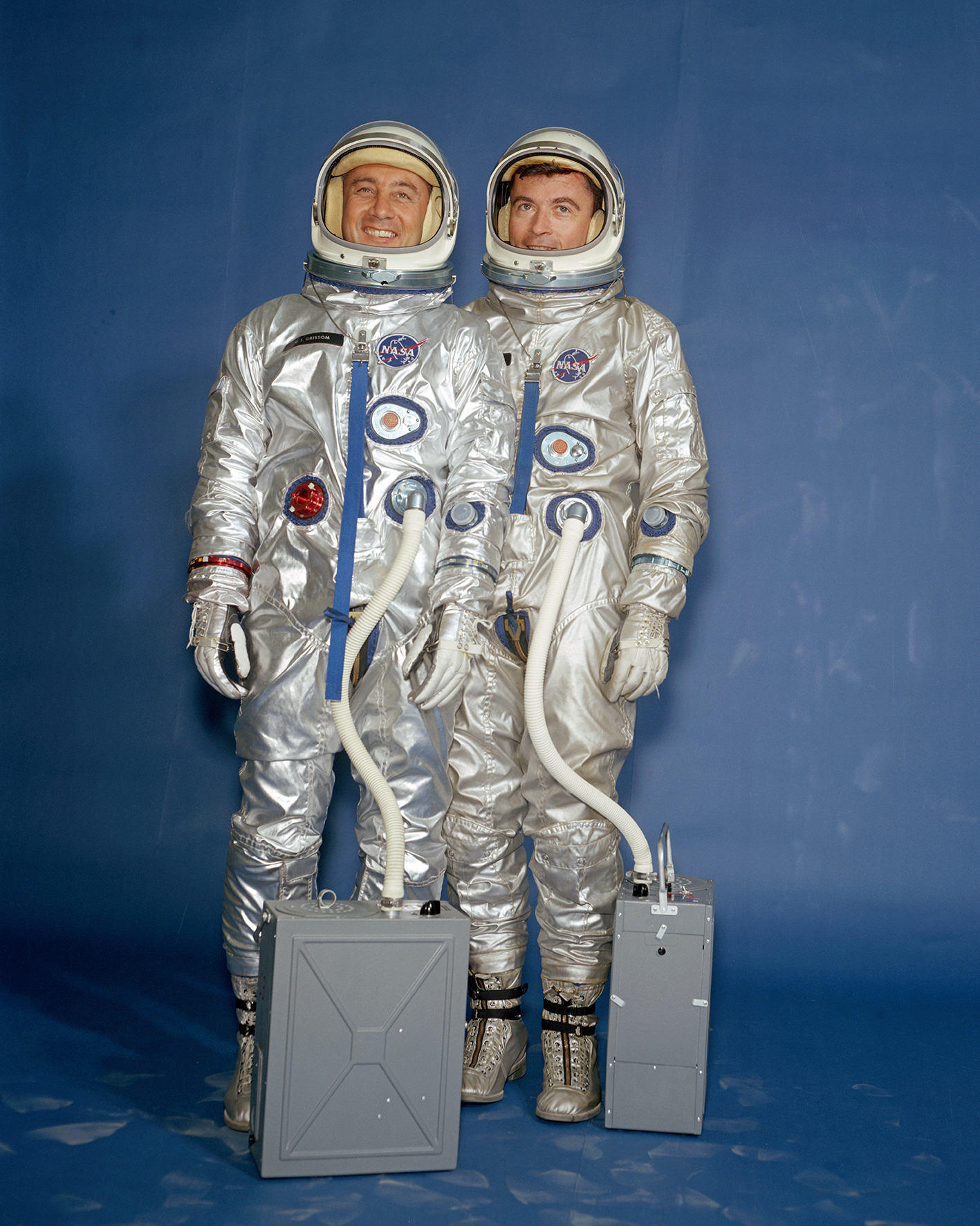
The Gemini 3 crew of Command Pilot Gus Grissom (left) and Pilot John Young, wearing their spacesuits and helmets, with portable air conditioners.
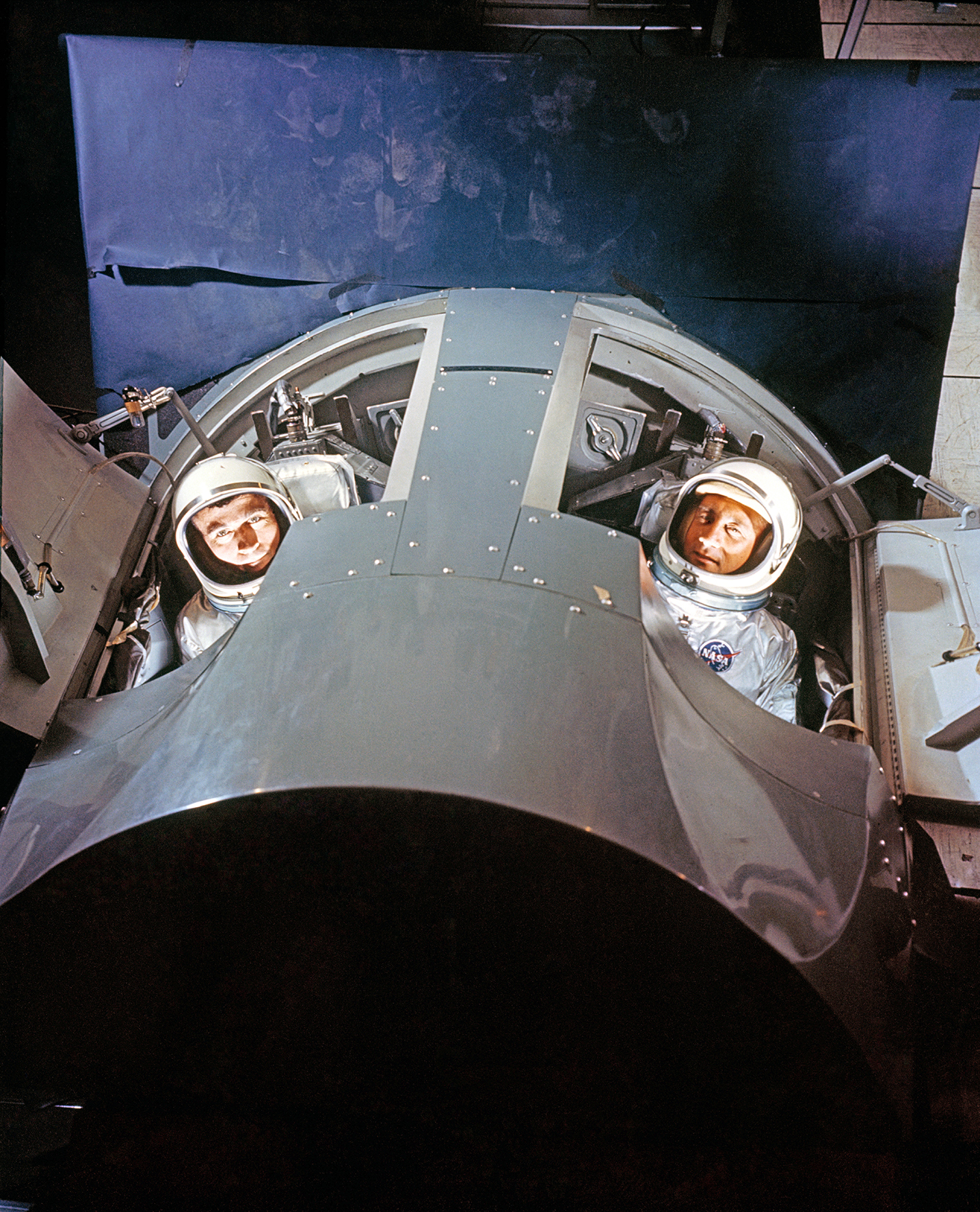
Young (left) and Grissom are shown inside a Gemini Mission Simulator at McDonnel Aircraft Corp in St. Louis, Missouri in early 1964 as they train for the first crewed flight of the programme.
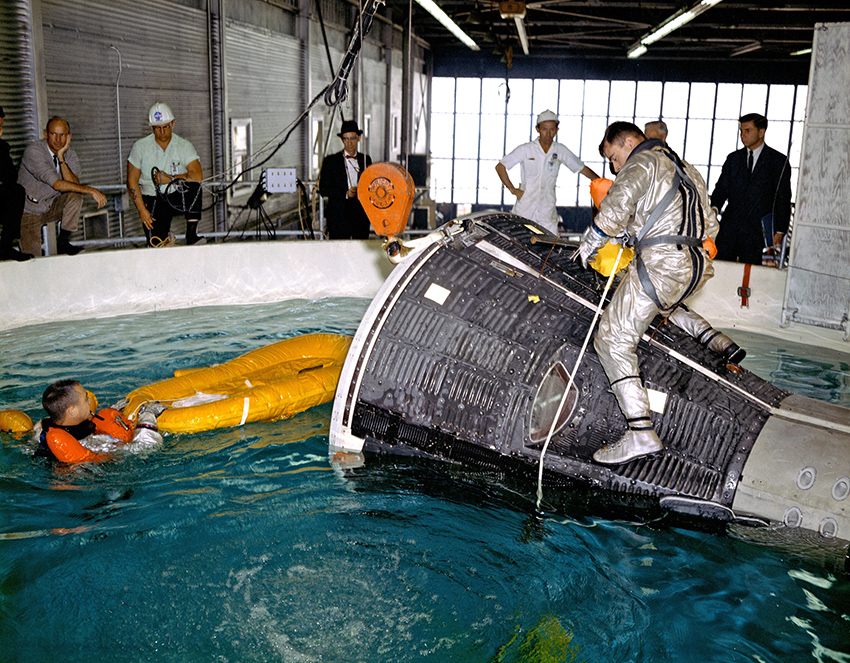
This 1965 image shows the Gemini 3 crew during water egress training at Ellington Air Force Base in Texas. John Young is on top of the Gemini capsule, while Gus Grissom is in the water with a life raft.
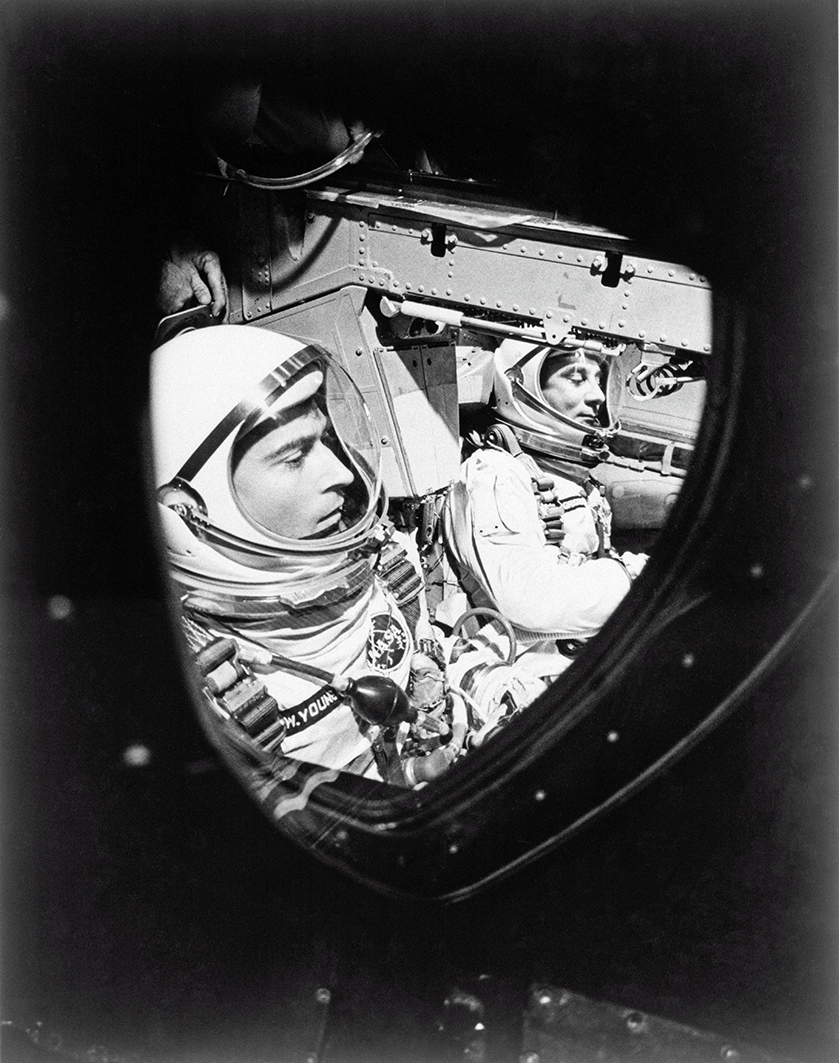
This image of Young and Grissom was taken through the open hatch on Young's side of the capsule on launch day, just prior to the hatches being closed.
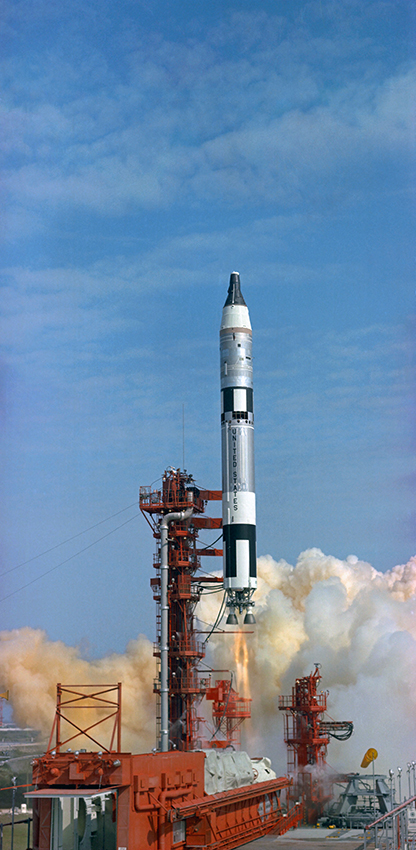
The launch of Gemini 3, at 09:24 EST on 23 March 1965.
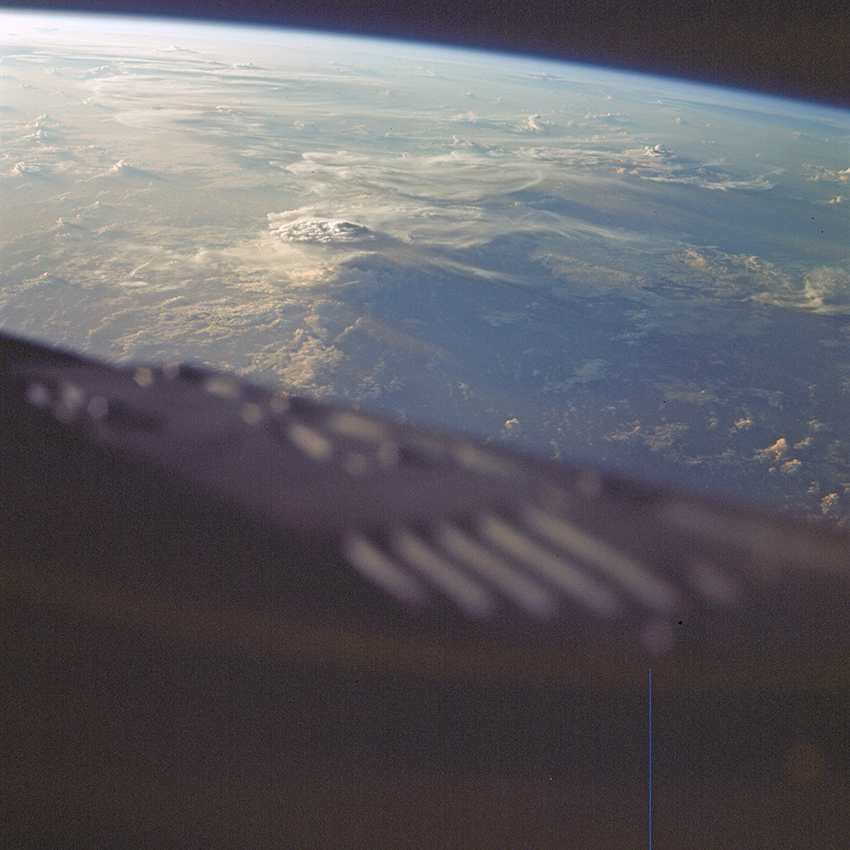
A view of Earth from orbit on Gemini 3. The variation in cloud cover was an issue for Grissom when attempting to track ground targets during the flight.
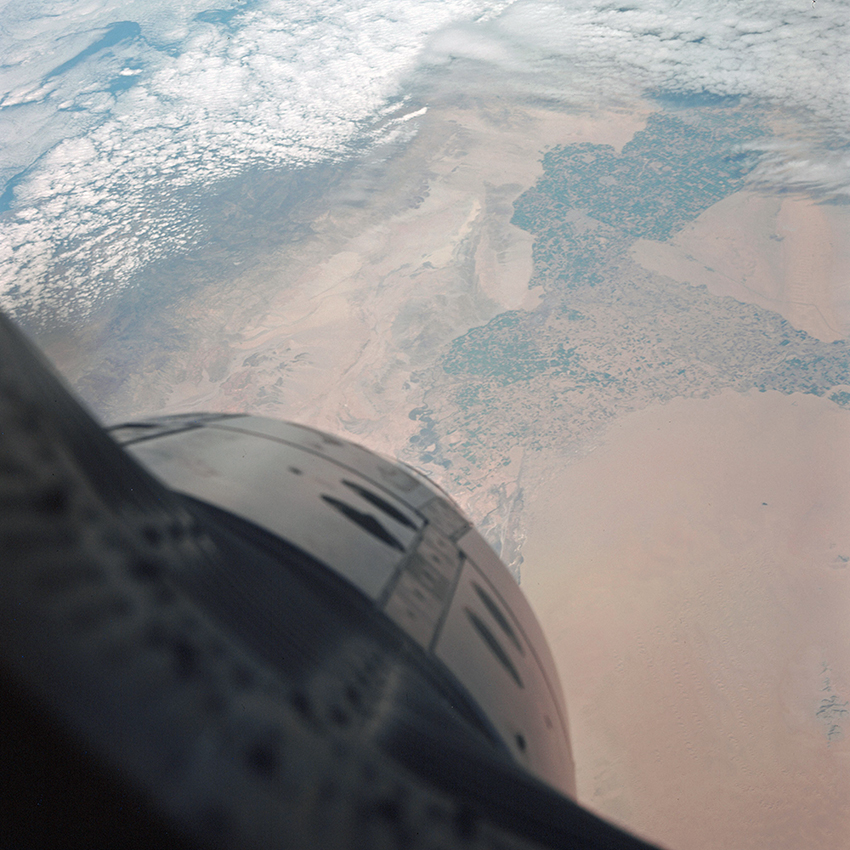
John Young took this image on the second orbit of the mission, using a 70mm Hasselblad camera. The image shows the Sonoran Desert (lower right), with the main portion of ground being Mexico (lower part) and California (upper part).
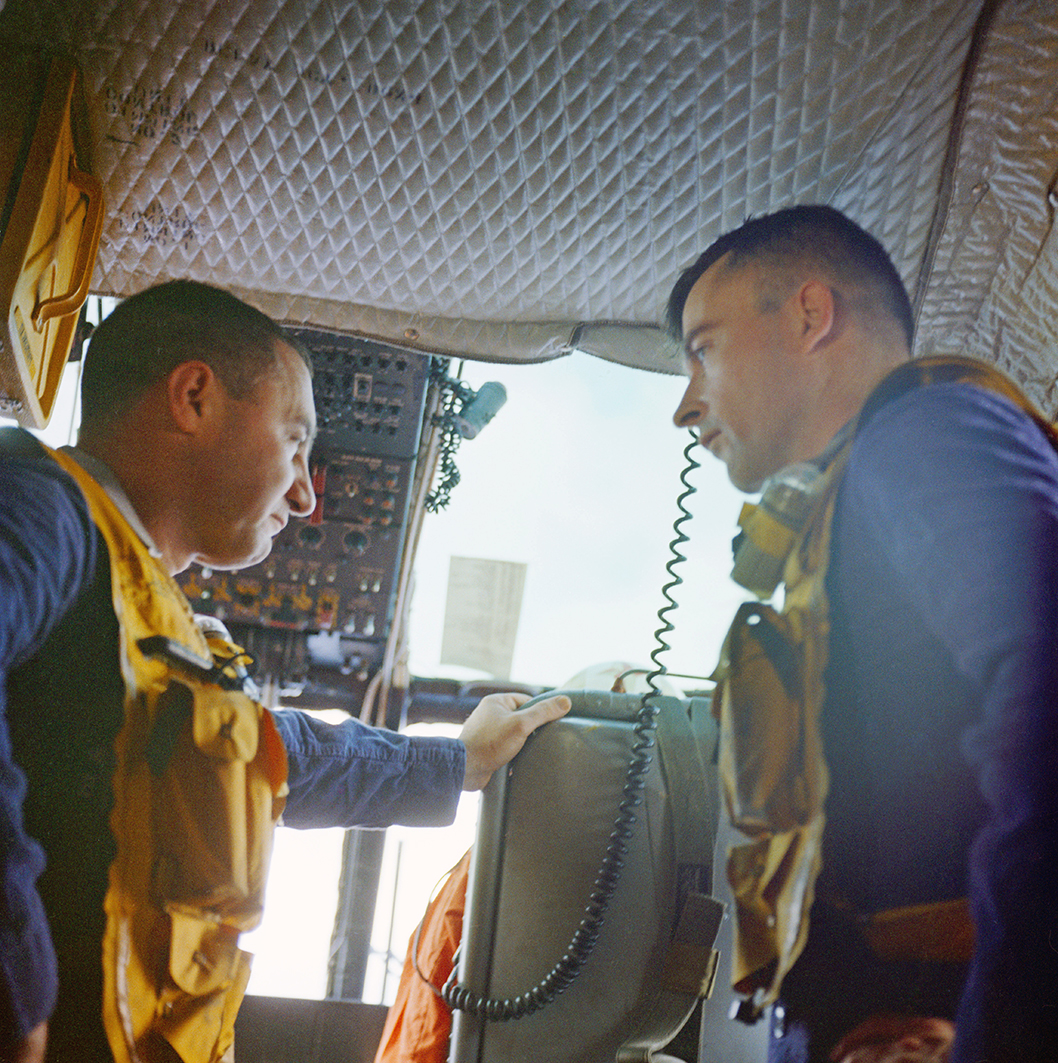
Having been recovered from the ocean after splashdown, Grissom (left) and Young discuss the events oftheir flight over the previous five hours during their helicopter flight to the prime recovery ship USS Intrepid.
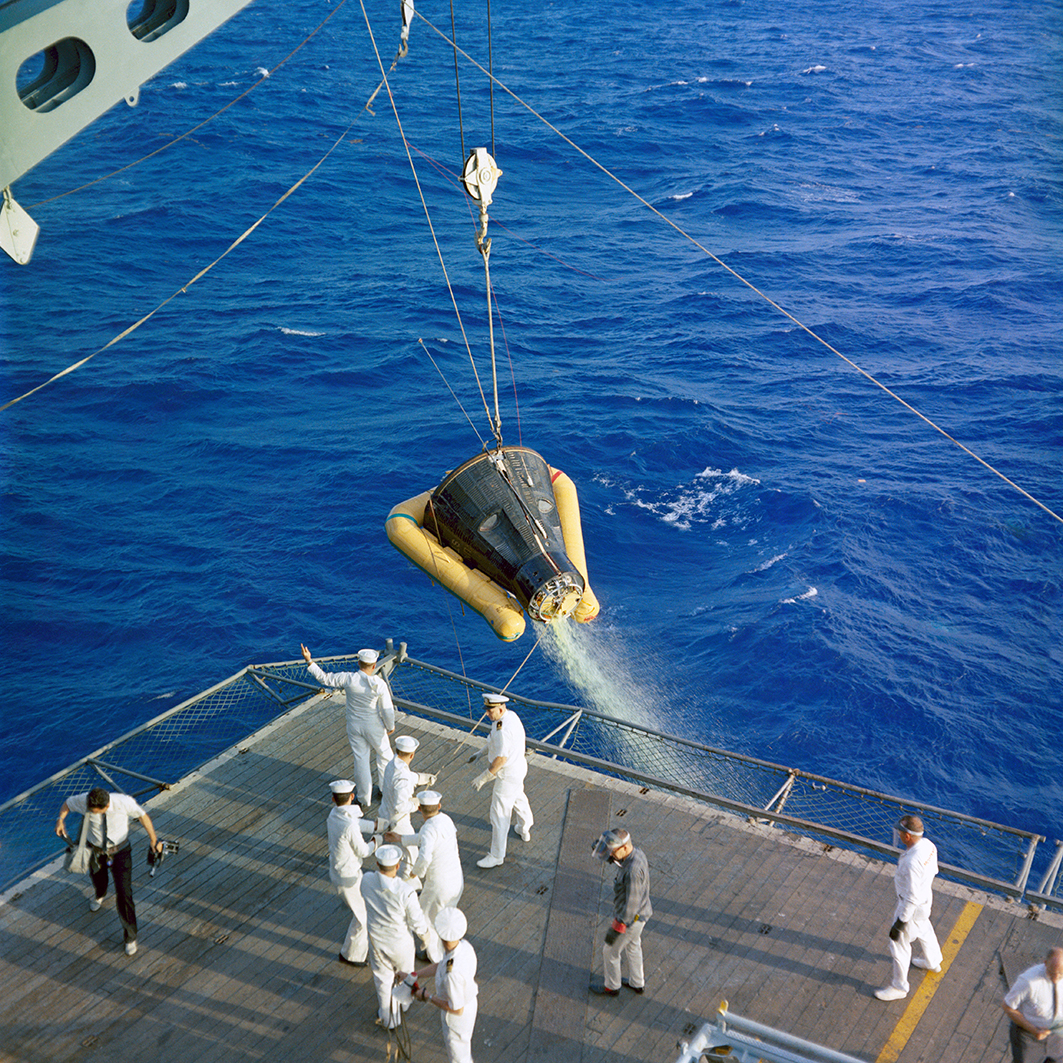
The Gemini 3 capsule is hauled aboard the USS Intrepid having been made safe by the pararescue divers who had also assisted the crew into the rescue helicopter.
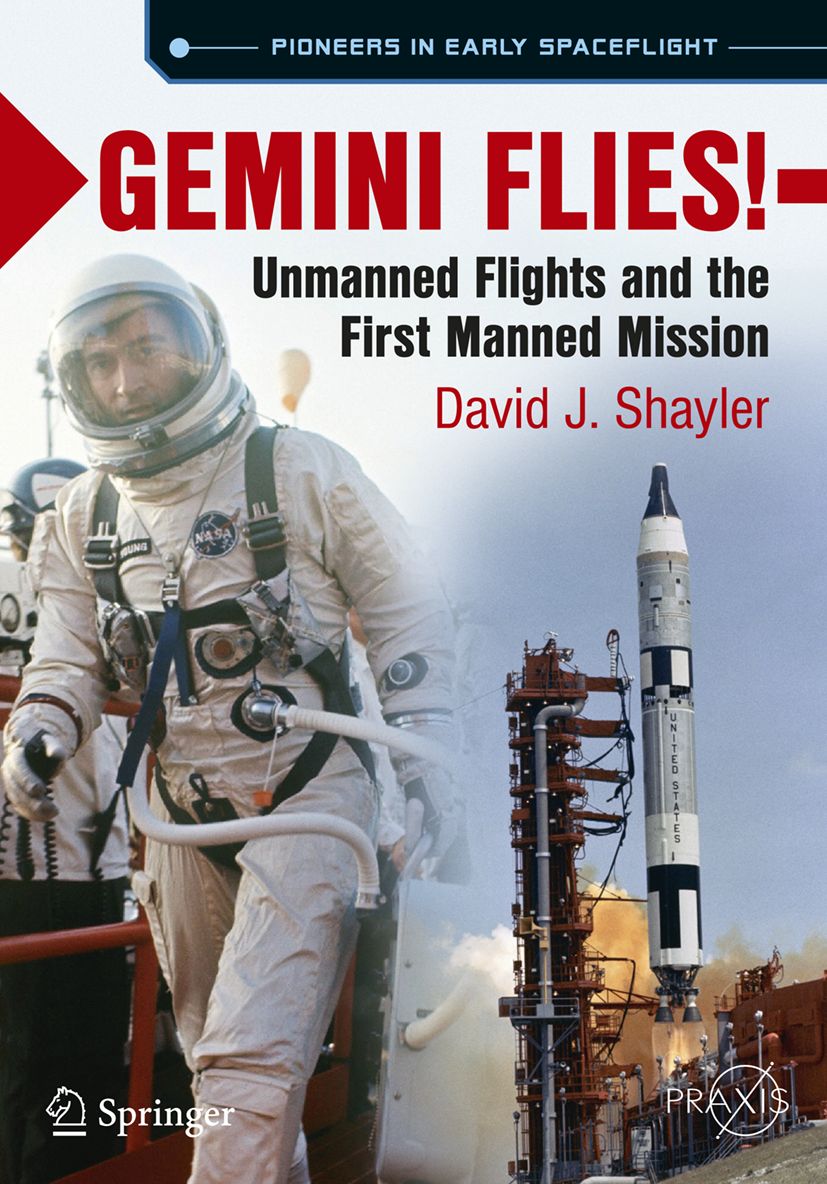
For the in-depth story of Gemini 3, see David Shayler's 2018 Springer-Praxis title GEMINI FLIES.
Further details can be found in our SHOP.