Astro Info Service Limited
Information Research Publications Presentations
on the Human Exploration of Space
Established 1982
Incorporation 2003
Company No.4865911
E & OE
Gemini 6
GEMINI 6 MISSION REPORT |
LAUNCH DATA |
|
|
Launch: |
15 December 1965, 13:37:26 UTC |
Launch Site: |
Pad 19, Cape Kennedy, Florida, USA |
Launch Vehicle: |
Titan II Gemini Launch Vehicle No. 6 (GLV-6) |
Spacecraft: |
Spacecraft No. 6 |
Spacecraft Mass: |
Approx. 3,546 kg (7,818 lbs) |
|
|
MISSION OBJECTIVE |
Demonstrate on-time launch procedures and station-keeping techniques during rendezvous with Gemini 7. Evaluate spacecraft re-entry guidance capabilities |
|
|
CREW DATA |
Crew Position |
Name |
Mission |
Command Pilot |
Walter M. 'Wally' SCHIRRA Jr, 42, US Navy |
2nd |
Pilot |
Thomas P. STAFFORD Jr, 35,
USAF |
1st |
|
|
Flight Crew |
2 |
Call Sign |
Gemini Six |
Back-Up Crew |
Virgil I. 'Gus' Grissom (Command Pilot)
John W. Young (Pilot) |
EVAs |
None (None planned) |
|
|
MISSION DATA |
Flight Duration |
1 day 1 hour 51 minutes 54 seconds |
Distance Travelled |
Approx. 694,415 km (431,489 miles) |
Orbital Data |
270 x 274 km (168 x 170 miles), with a period of 89.5 minutes |
Landing |
16 December 1965, 15:28:20 UTC |
|
|
The original mission of Gemini 6 was intended to be a short one- or two-day flight, flown by Wally Schirra and Tom Stafford and featuring the first physical docking in space with another vehicle, in this case the previously launched Agena target craft. Under this plan the Agena would be launched into orbit first, followed about 100 minutes later by Schirra and Stafford in Gemini 6. Entering orbit some 1,931 km (1,200 miles) behind the target, they would gradually close in over the next three orbits until finally nudging the nose of Gemini into the docking cone of Agena during their fourth orbit, about 5 hours 30 minutes into the mission. The crew would then conduct two hours of docking tests before undocking, conducting a fly-around inspection and then re-docking up to three more times. Two of these would be during a night pass.
This challenging programme was designed to achieve the final major objective of Gemini in preparation for the Apollo missions to the Moon. In the three crewed Gemini missions to date there had been two long flights of four and eight days, with America's first tentative spacewalk completed on the shorter of the two. After Gemini 6 had proved the docking concept, the next mission would attempt a 14-day space marathon. This would be followed by five missions in 1966 to gather more experience of rendezvous, docking and Extra-Vehicular Activity (EVA). Together, these Gemini missions would provide the platform to conduct the Apollo lunar missions, with Gemini 6 an important step in that direction. But first the Atlas rocket had to place the Agena target into orbit.
"Daddy Will Be Upset"
The Atlas successfully carried the Agena off the pad on 25 October. A few minutes later the target separated from the booster. Suddenly, at 6 minutes 20 seconds into the mission, there was a total loss of telemetry from the Agena, indicating its demise and, for the time being, the cancellation of the Gemini 6 mission. After almost 90 minutes of lying on their backs on the launch pad, Schirra and Stafford were pulled from their spacecraft, fully aware that there would not be another Agena ready for launch until early 1966. As Schirra's young daughter noted when looking at the expression on her father's face on TV as they left the launch pad, "daddy" was not a happy man.
At the time of the aborted launch, there was a suggestion that Gemini 7 - planned for that December - could be used as a substitue target for Gemini 6. Without physically docking, the two spacecraft would still be able to approach to within a few feet of each other to demonstrate close proximity flying, a pre-requisite of rendezvous and docking. By using the same launch pad, a 'rapid-fire' or 'salvo' launch operation could also be demonstrated. As radical as it sounded, support for the plan soon grew as the reason for the Gemini 6 target vehicle's failure became apparent. The cause was probably an electrical short-circuit, or a "hard-fire back-start" (the rocket equivalent of a car backfiring). The Gemini 6 launch vehicle would not be able to launch Gemini 7, which was too heavy due to mass requirements for its long duration mission. Gemini 7's designated Titan was installed on the pad instead and the exchanged Gemini 6 Titan de-stacked for temporary stowage.
Gemini 7 flies... Gemini 6 does not
On 4 December, Frank Borman and Jim Lovell were launched in Gemini 7 to start their 14-day space marathon. As soon as the spacecraft had entered orbit, work began on preparing Launch Complex 19 for Gemini 6 and its Titan launch vehicle. With less than two weeks to turn the pad around it was going to be a tight schedule, but by 12 December Schirra and Stafford were back inside their Gemini atop the Titan on Pad 19, counting down for launch once again. As Gemini 7 flew overhead on its eighth day in orbit, the engines of Gemini 6 roared into life... then promptly shut down again after just 1.2 seconds. "We saw it ignite; we saw it shut down," the Gemini 7 astronauts reported from orbit. Inside Gemini 6, seasoned veteran Schirra knew there had been no launch and instinctively felt that the Titan was sitting safely on the pad and not about to explode. He chose not to eject and neither did Stafford, although the rookie pilot's choice words were bleeped out by NASA and in the short time delay the 'live' commentary was changed to a more acceptable "Oh shucks!"
Schirra had immediately realised that the booster had not ignited as it should have. He also realised that it was not about to topple over and therefore there was no need to eject. In fact, he decided they were safer remaining where they were until the ground crews came to extract them once again. By this time, there were just six days left in the Gemini 7 mission, so the race was on to find out what had happened on Gemini 6 and try another launch attempt in three days time. It was discovered that an umbilical connector had prematurely separated from the base of the Titan, triggering the Malfunction Detection System. In a separate investigation, it was found that a plastic dust-cap had been inadvertently left in the engine oxidiser inlet port, which would have shut off the engines anyway after about a second if the computer had not already done so. Schirra's coolness in the situation saved the vehicle and the mission for another day.
"For the third time, GO!"
On 15 December, Schirra and Stafford were once again aboard their Gemini spacecraft. The mission was now designated '6A' having been amended from its original docking objective. This time they finally left the launch pad as intended and entered orbit some 1,992 km (1,238 miles) behind Gemini 7. They began a five-hour chase of the other spacecraft, using an M=4 rendezvous profile. This required a series of gradual increases in velocity and altitude over three elliptical orbits to manoeuvre the spacecraft. A fourth, circular orbit was flown to arrive at a point in space near the target, where manual control could be used to complete the final approach and rendezvous. At Ground Elapsed Time (GET) 5 hours 16 minutes into the mission, Schirra was close enough to Gemini 7 to thrust his spacecraft directly towards it. After a few more small manoeuvres, the distance between the two vehicles had been reduced to about 36.5 metres (120 feet) and station-keeping operations began.
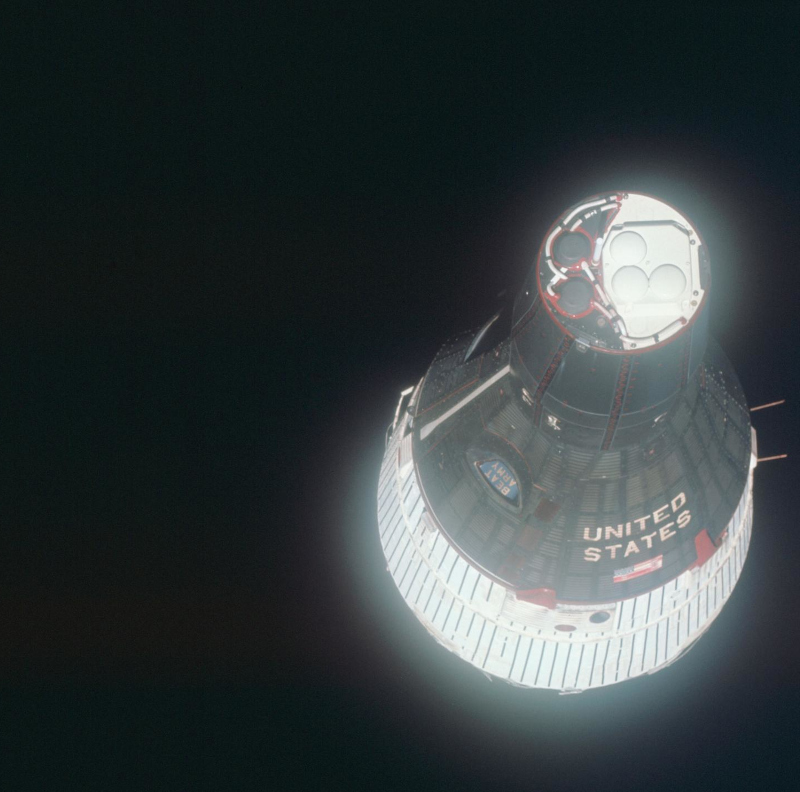
Over the next three revolutions, Schirra flew Gemini 6 around its twin at a velocity of 0.03 m/sec (0.1 fps) while travelling at 28,163 kph (17,500 mph), with the distance between them ranging from 91 m (300 ft) to less than 0.3 m (1 ft) at one point. It was not all work though. Both crews, all military officers, took turns to taunt one another about the forthcoming 1966 American Football season. Former US Navy (USN) graduates Schira and Stafford (as was Lovell over in Gemini 7) placed a sign in their window that read "Beat Army" (meaning US Air Force), aimed at West Point graduate and USAF pilot Frank Borman. Borman erroneously informed Mission Control, who did not have TV coverage of the event, that the sign said "Beat Navy", throwing the joke back on Schirra.
A notable milestone in human space flight had been achieved in bringing the two Gemini spacecraft together. After 5 hours and 18 minutes of joint operations, it was concluded that arriving at a particular point in space in order to dock with another target vehicle would not be a problem. With that, Schirra turned Gemini 6 around and, after a short burn, imparted a 16 km (10 mile) distance between the spacecraft for the night's sleep.
Gemini 6 was the final battery-powered vehicle of the series and was limited to a two-day flight duration at most. According to Schirra, with no EVA planned and rendezvous as the primary objective, a one-day mission would be flown if the rendezvous was successful, as everything else - including science experiments - was secondary.
An Object Going From North to South
At the start of 16 December, Stafford informed both the ground and his colleagues in Gemini 7 that they had spotted an object in polar orbit about to re-enter the atmosphere. Then, over the airwaves, came the sounds of jingle bells played by Stafford and a harmonica played by prankster Schirra, adding some Christmas spirit. These were the first musical instruments played in space and in 1967 the astronauts donated them to the National Air and Space Museum in Washington for public display.
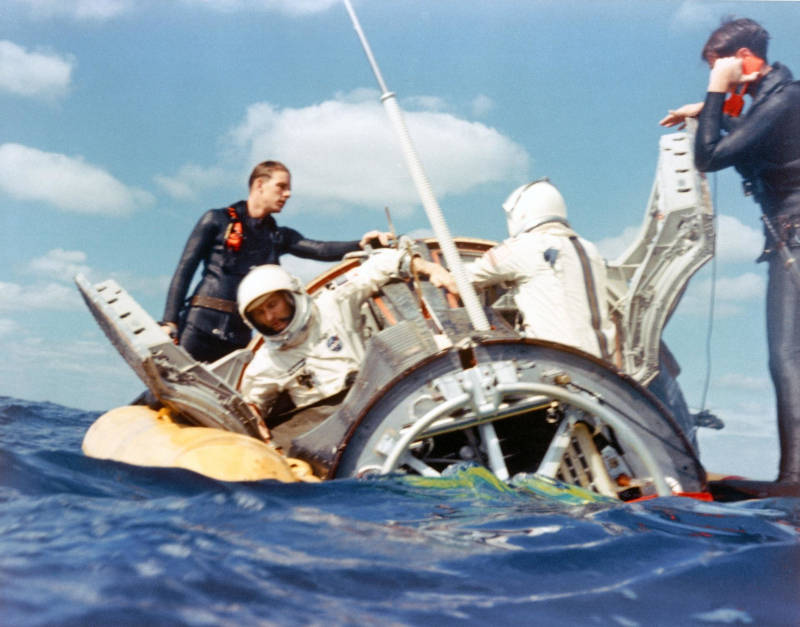
After wishing their colleagues good luck for the rest of their flight, the Gemini 6 crew prepared for their recovery and completed the first successfully controlled re-entry and nominal splashdown. The Gemini 6 splashdown was the first to be televised live via satellite from the recovery vessel. As with his 1962 Mercury flight, Schirra elected to be picked up with the spacecraft after splashdown, a decision he would also make for his last flight on Apollo 7 three years later.
Gemini 7 returned to Earth two days after Gemini 6, ending a memorable year for American space flight. Together, the dual flight had notched up some considerable space firsts and cleared the way for more advanced rendezvous, docking and EVA operations during 1966.
After Gemini 6A
Following the mission, Wally Schirra moved over to the Apollo programme, initially as Commander of the second Block I Earth orbital flight test, designated "Apollo 2". When that mission was cancelled as unnecessary in November 1966 he was reassigned as Back-up Commander for the planned 14-day Apollo 1 mission, until the pad fire at Cape Kennedy on 27 January 1967 claimed the lives of the Apollo 1 crew. During the recovery from that tragedy, Schirra was assigned as Commander for the new 11-day Earth orbital maiden crewed Apollo shakedown flight, now designated "Apollo 7". The mission flew in October 1968. Wally Schirra did not fly in space again, leaving NASA in July 1969 to enter business and become a TV news consultant. He was the first person to orbit the Earth on three separate missions and the only astronaut to fly on Project Mercury, Gemini and Apollo. He died in 2007 aged 84.
Tom Stafford received a third Gemini assignment as Back-up Commander of Gemini 9 and was in line to fly as Command Pilot for the final flight, Gemini 12. Then, in February 1966, a tragic accident claimed the lives of the Gemini 9 prime crew Elliott See and Charles Bassett, resulting in Stafford and Pilot Gene Cernan flying the mission. After Gemini 9, Stafford also moved over to Apollo, becoming Senior Pilot (Command Module Pilot - CMP) on the back-up crew to Schirra's Apollo 2 mission. When the crews were reassigned, Stafford was given command of his own crew, with John Young as CMP and Gene Cernan as Lunar Module Pilot (LMP). The crew flew Apollo 10 to the Moon in May 1969, with Stafford and Cernan descending to within nine miles of the lunar surface in the Lunar Module before returning to join Young in the Command Module and heading home. In June 1969, Stafford succeeded Al Shepard as Chief Astronaut while Shepard trained for and flew Apollo 14. In 1975, Stafford flew his final mission as Commander of the American half of the joint Apollo-Soyuz Test Project (ASTP) mission with the Soviets. He left NASA in November 1975 to assume command of the USAF Flight Test Center at Edwards AFB, California. Stafford died on 18 March 2024 aged 93.
This mission report is copyright Astro Info Service Limited, 2018, 2026.
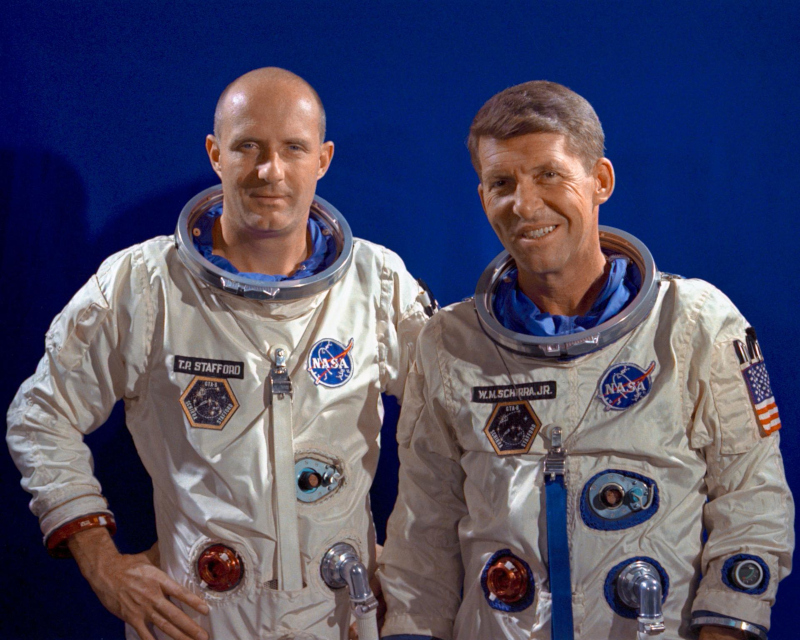
The Gemini 6 astronauts pause for a crew portrait during a suiting up exercise a few days before the initial launch attempt in October 1965. Pilot Tom Stafford is on the left, Command Pilot Wally Schirra on the right. Image courtesy of NASA.
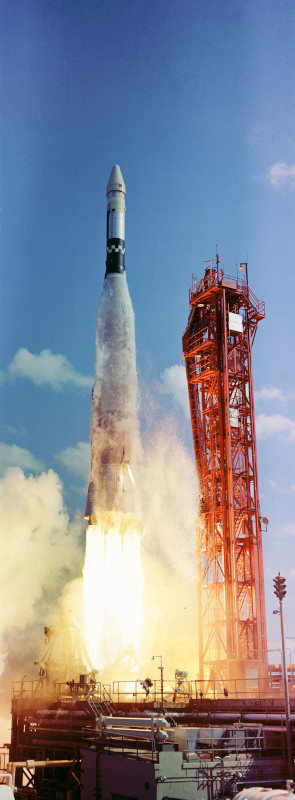
Launched from Pad 14 aboard an Atlas rocket on 25 October 1965, the Agena craft intended as the rendezvous target for Gemini 6 failed to achieve orbit, resulting in the original Gemini 6 mission being scrubbed. Image courtesy of NASA.
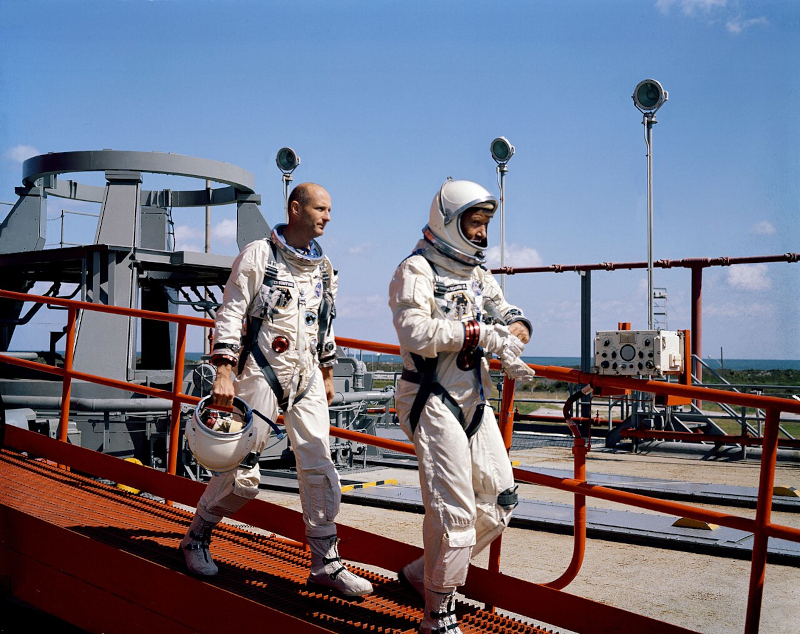
After 90 minutes lying on their backs in their spacecraft awaiting launch, Stafford (left) and Schirra are seen walking down the ramp from Pad 19, their Gemini 6 mission scrubbed following the Agena failure. Image courtesy of NASA.
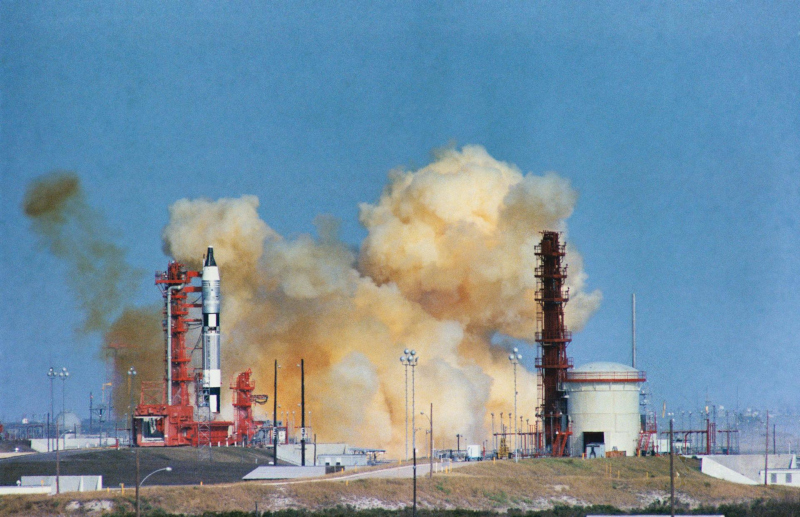
Now designated Gemini 6A, the next attempt to launch the mission, on 12 December 1965, was aborted just over one second after ignition, when the Malfunction Detection System shut down the engines due to a faulty umbilical connector separating prematurely at the base of the Titan rocket. Image courtesy of NASA.
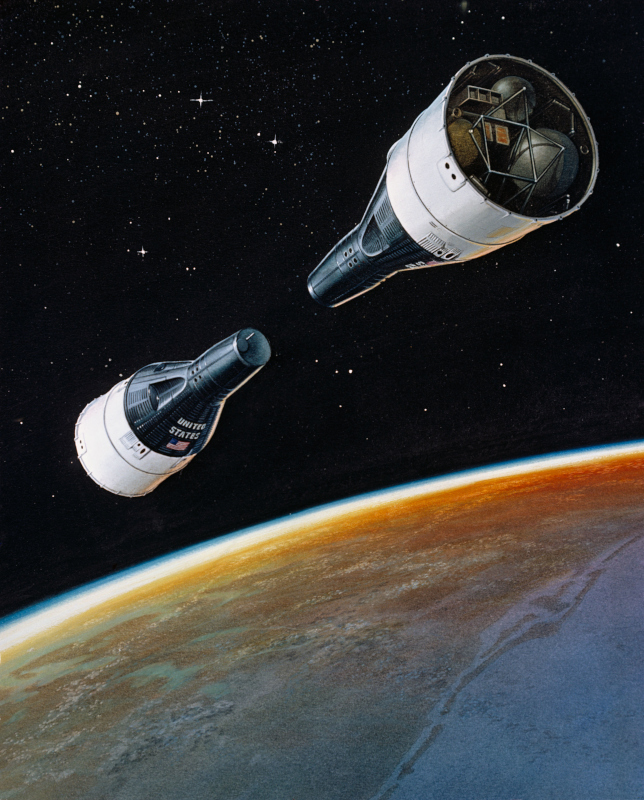
With no new Agena vehicle available until 1966, the Gemini 6 mission was revised to rendezvous with the long duration Gemini 7 spacecraft instead, as imagined in this artist's impression. Image courtesy of NASA.
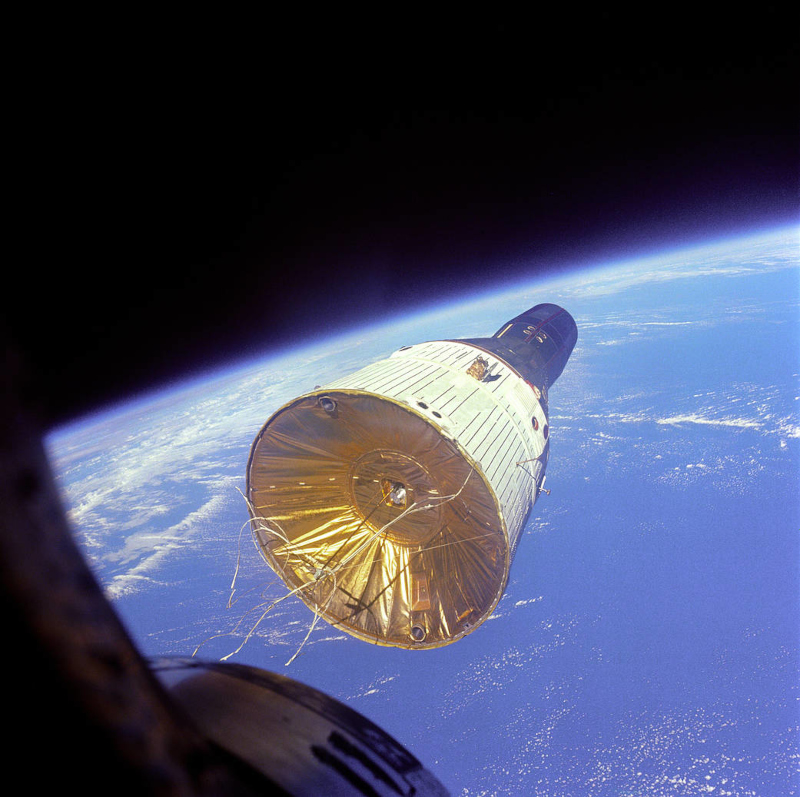
Third time lucky, as Gemini 6 finally launched on 15 December 1965, with only three days left to achieve the rendezvous with Gemini 7 before that mission was due to return home. This image shows Gemini 6 in Earth orbit, photographed by the crew of Frank Borman and Jim Lovell in the nearby Gemini 7. Image courtesy of NASA.
This nose-on view of Gemini 6 was also taken from Gemini 7, flying approximately 12 m (40 ft) away. The window in the lower left side of the spacecraft (to the left of the word 'United') shows the "Beat Army" sign displayed by the US Navy crew of Schirra and Stafford aboard Gemini 6. Image courtesy of NASA.
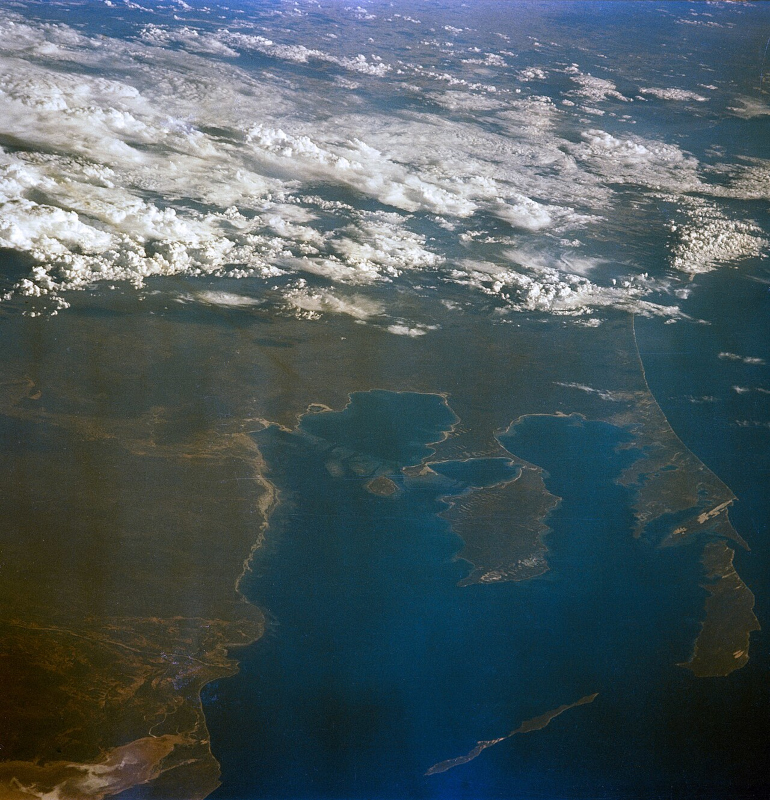
This image, taken from orbit by the Gemini 6 crew, looks southwards over Shark Bay on the coast of Western Australia. A NASA ground tracking station was located in the city of Canarven, which is in the lower left corner of the image near the mouth of the river. Image courtesy of NASA.
Stafford (left) and Schirra can be seen emerging from the spacecraft hatches following splashdown at the end of the Gemini 6 mission on 16 December 1965. Navy divers standing on the spacecraft's floatation collar assisted the astronauts with hatch opening. Image courtesy of NASA.